Modular Autonomous Factories, built to scale.
Forge Robotics is building Modular Autonomous Factories. Shipping container sized modules that can manufacture anything. Snap them together to scale capacity without scaling headcount.
// vision
Factories of the future.
U.S. manufacturing faces a structural labor gap: around 415,000 unfilled jobs today, and an estimated 3.8 million new workers needed by 2033. Traditional factories can't hire their way out of it.
Forge replaces rigid production lines with shipping container sized modules that snap together on the shop floor. Each module is self-contained, configurable in software, and runs 24/7 without operators.
Every module sees, decides, and adapts. Sub-millimeter vision closes the loop between the digital model and physical reality, so parts come out right the first time, every time.
// capabilities
Built on four core pillars.
Measure, then build.
You can only build as well as you can measure. Our sensors achieve sub-millimeter accuracy.
Days, not months
Forge modules are up and running within a week. To double capacity, add more modules. Production doubles another week later.
Autonomous operation
Describe the job. The module plans, welds, scans, and verifies. No teach pendant.
First-pass line yield
Every part is scanned and verified in-line, so defects never leave the floor. Our lines hit 99% first-pass yield.
// virtual tour
Walk through a modular autonomous factory.
Here's what a Forge factory looks like end to end. Each module is a self-contained process that can carry out any manufacturing task.
Parts arrive at the logistics module.
Raw stock rolls into a dedicated logistics module that acts as the loading dock for the whole factory. It identifies each part, matches it to a job, and routes it on to the right production module.
- →Material is autonomously loaded and unloaded from trucks using AGVs
- →Dedicated logistics module at the factory entrance
- →Standard pallet footprint, no custom material handling
- →Parts identified by geometry, not barcodes
- →Jobs queued by software, not by a shift supervisor
Every part gets its own digital twin.
A sub-millimeter 3D scanner captures the as-built geometry of each part, checks it against CAD, and flags defects on the spot. Every part is classified as suitable or unsuitable before it reaches a production module.
- →<100 µm accuracy on features of interest
- →Per-part digital twin drives all downstream modules
- →Defects detected before any production work starts
- →Unsuitable parts flagged and diverted automatically
Production modules do the work.
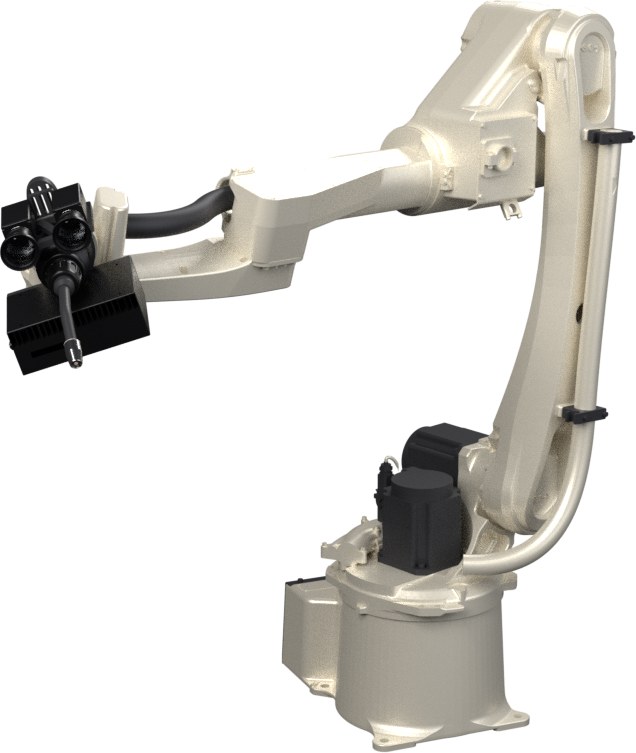
Each production module handles one step of the manufacturing line: welding, machining, fastening, finishing, and more. Modules use the part's digital twin to plan their own path, adapt to variation, and verify their own work in real time.
- →Any step in the line, not just welding
- →Vision-guided, adapts to part variation
- →No teach pendant or custom fixturing
- →Every operation logged with traceable quality data
AGVs move parts between modules.
Autonomous guided vehicles shuttle parts from module to module, routing each one through the exact sequence of production steps its job requires. No forklifts, no manual handoffs.
- →Autonomous routing between modules
- →Each part takes its own path through required modules
- →Scales with the factory: add modules, add AGVs
- →No operator required for material handling
Laser engraving for serialization & compliance.
Each finished part is marked with a serial, 2D code, or brand. Traceable from scan to ship.
- →Metal, polymer, composite
- →Serial numbers, 2D codes, logos
- →Linked to the part's digital twin
Every part is scanned again, then out the door.
A final scan verifies the finished geometry and catches defects before parts ship. Quality reports are generated automatically and attached to every batch.
- →100% inspection, not sampling
- →Automated quality reports per batch
- →Bad parts flagged before they leave the floor
Want to talk through your use case?
We'll walk you through how a Forge factory would fit your production.